Introduction to Wiccan Festivals and Celebrations
Understanding the Wiccan Wheel of the Year and the Wiccan Esbats
If you’re curious about Wicca, a key element to understand is how Wiccans mark the passage of time through celebrations or Sabbats and Esbats. These are not just rituals or festivals but meaningful ways to connect with the natural world and its cycles. In this section, I’ll guide you through the Wiccan Wheel of the Year and the Sabbats that make up this yearly cycle. Before we move into Esbats—monthly celebrations that align with the phases of the moon.
The Wiccan
Wheel of the Year
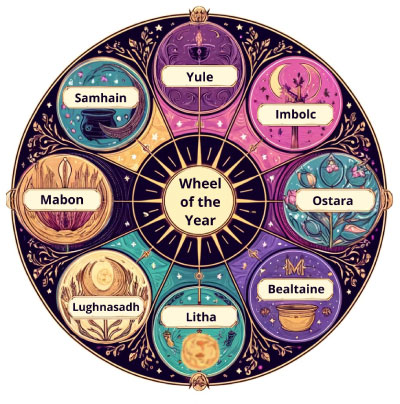
The Wheel of the Year is a Wiccan calendar that features eight festivals, known as Sabbats. These Sabbats honour the Earth’s journey around the sun and the cycles of nature. Each festival has its own unique character and way of connecting practitioners to the seasonal energies.
Keep in mind that, while they fall around a certain date, the exact dates of the Solstices and Equinoxes can vary year-on-year. So, it’s a good idea to mark them in your calendar, or buy a witch’s almanac, every year.
The Wheel of the Year
1. Samhain (October 31st/November 1st) Pronounced Sow-wen (“Sow” like “cow”)
Often considered the Wiccan New Year, Samhain marks the end of the harvest and the beginning of winter. It’s a time for remembering the dead and celebrating the cycle of death and rebirth.
2. Yule – Winter Solstice (December 21st/22nd/23rd) Pronounced Yool (“Yool” like “cool”)
Yule celebrates the longest night and the rebirth of the sun. It’s a festive time, honouring the sun’s light returning to the earth, symbolizing hope and renewal.
3. Imbolc (February 1st) Pronounced Im-bulk (“Im” like “in”)
Imbolc heralds the coming of spring. It’s a time to celebrate the awakening of the land and the growing power of the sun. Traditionally, it’s a time for purification and light, often associated with the goddess Brigid.
4. Ostara – Spring Equinox (March 21st/22nd) Pronounced Oh-star-ah
Ostara is the spring equinox when day and night are of equal length. This festival celebrates new growth, fertility, and balance.
5. Bealtaine or Beltane (May 1st) Pronounced Bee-YAL-tinna
Bealtaine marks the beginning of summer. It’s a celebration of fertility, fire, and abundance, often observed with lighting of fires and maypole dances.
6. Litha – Summer Solstice (June 20th/21st/22nd) Pronounced Lee-tha
Litha, or the summer solstice, is the longest day of the year. It’s a time of strength and power, celebrating the fullness of life and the sun at its peak.
7. Lughnasadh or Lammas (August 1st) Pronounced Loo-nah-sah
The first of the harvest festivals, Lughnasadh celebrates the grain harvest. It’s a time of giving thanks for abundance and sharing with others.
8. Mabon – Autumn Equinox (September 21st/22nd/23rd/24th) Pronounced Ma-bon
Mabon is the second harvest festival, marking the autumn equinox when day and night are again of equal length. It’s a time of thanksgiving and balance.
The Sacred Dance: A Tale of the God and Goddess Through the Wheel of the Year
Another way to understand the Wheel of the Year is through the God and Goddess. The God and the Goddess dance their eternal dance, weaving the fabric of the seasons through their union, each Sabbat a chapter in their divine story.
Samhain: The Parting Veil
As the Wheel turns to Samhain, the air fills with the crisp scent of falling leaves and distant fires. It is the time when the Goddess, clad in her cloak of twilight, rules as the Crone, guardian of wisdom and change. The God, now the aged Horned Hunter, prepares to depart to the otherworld, his presence a gentle shadow fading with the daylight. Their parting at Samhain is a poignant reminder of the cycle of life and death, promising rebirth and a reunion in the cosmic dance.
Yule: Rebirth and Renewal
In the darkest of nights, Yule arrives with the promise of light’s return. As the Goddess nurtures the newborn sun, the God is reborn. This Sabbat celebrates their renewal and hope, symbolising new beginnings and the invincible sun that shines anew. The God’s rebirth under the Goddess’s tender care mirrors the rebirth of the sun, casting a light of hope across the frozen earth.
Imbolc: Awakening and Purity
Imbolc breaks the winter’s hold with the stirring of life beneath the snow. The Goddess, now the Maiden of spring, readies the earth for renewal with her gentle touch and pure heart. The young God, growing in strength, symbolises the burgeoning sun, his vitality a promise of the returning light and warmth. Their youthful energies at Imbolc speak of preparation and purification, setting the stage for renewal across the world.
Ostara: Balance and Blossoming
At Ostara, the vernal equinox, day and night find balance, and the God and Goddess stand as equals, he as the burgeoning Green Man, she as the radiant Maiden. Their dance brings fertility to the land, sparking the blooming of flowers and the rush of spring’s waters. This Sabbat celebrates the flowering of life, the divine couple’s union bringing vitality and growth.
Bealtaine: Union and Fertility
With Bealtaine come the fires of passion and the sacred marriage between the God and Goddess, now in their peak of power and allure. The God and the Goddess, consummate their love, their union ensuring the Earth’s abundance. Bealtaine’s fires represent their passion, a symbol of life flourishing under their care and love.
Litha: Power and Sacrifice
The summer solstice, Litha, baths the Earth in the longest light, the God at his zenith, powerful yet cognisant of his impending decline. The Goddess, full and nurturing, presiding over the earth’s bounty. Their strength at Litha is a reminder of the stewardship required to maintain balance, the God beginning his sacrifice of strength to ensure the cycle continues.
Lughnasadh: Harvest and Sacrifice
At Lughnasadh, the first of the harvests begins, and the community celebrates the God, who willingly sacrifices his life for the nourishment of all. The Goddess, in her aspect as Mother, manages the abundance, ensuring that all are cared for. This Sabbat is a reflection on sacrifice and the nourishment that comes from giving.
Mabon: Balance and Gratitude
Mabon, the autumn equinox, brings another moment of perfect balance between light and darkness. The God, now aged and wise, and the Goddess, in her aspect as the wise Crone, together celebrate the second harvest. This time of balance and thanksgiving honour the gifts of the land, the wisdom of the God and Goddess, and the preparations for the coming winter months.
Through the Wheel of the Year, the sacred union of the God and Goddess not only propel the cycles of nature but also teach the vital lessons of life, love, sacrifice, and rebirth. Their dance is a perpetual testament to the beauty and balance of the natural world.
Northern Hemisphere vs Southern Hemisphere
The Wheel of the Year above reflects the seasonal changes and astronomical events as they occur in the Northern Hemisphere. However, Wiccans and Pagans in the Southern Hemisphere often adapt these celebrations to align with their local seasons and climate, which are opposite to those in the Northern Hemisphere. So, for example, when witches in the Northern Hemisphere are celebrating Ostara, Southern Hemisphere witches may be celebrating Mabon (the opposite point on the wheel).
Adapting Celebrations to Local Conditions
Wiccans in the Southern Hemisphere often adjust their practices not just for the season, but also for local weather patterns and ecological features. For example, the traditional symbols and decorations used during these festivals might change based on what is locally available or relevant.
Cultural and Personal Wheel of the Year Adaptations
In addition to hemispherical considerations, individual practitioners might also tailor the celebrations to better fit personal, familial, or local cultural significances. This flexibility allows Wiccans and Pagans to practice their faith in a way that is meaningful and relevant to their surroundings, emphasizing the religion’s connection to nature and the Earth’s cycles.
This adaptability in the practice of Sabbats between the hemispheres beautifully illustrates Wicca’s deep respect for nature and its cycles, and emphasises the importance of staying connected and aligned with one’s environment. Whether in the North or the South, these celebrations foster a sense of unity with the natural world and help practitioners live in harmony with the rhythms of nature.
Making the Wheel Work for You
That being said, it is down to each solitary witch or coven to determine the practices that work for them. For example, if you grew up in the Northern Hemisphere and you find yourself temporarily in the Southern Hemisphere, you may choose to continue celebrating the Wheel of the Year as you normally would, or you may feel more comfortable adapting your celebrations to your surroundings. Do what feels authentic to you! Personally, when I lived in the Southern Hemisphere for a couple of years, I did hybrid celebrations. I would celebrate the point of the wheel where I was living but also take time to acknowledge the point of the Wheel being celebrated back home.
Following the Wheel
When you follow the Wheel of the Year, you may find aligning with nature’s cycles brings you more into alignment with your own energy. It’s also important to consider that these festivals represent seasonal energies that last longer than the day, or couple of days, most celebrate them. So, you may find yourself influenced by those seasonal energies longer than the official celebration.
Think of all those people who make new year’s resolutions to get fit and begin their fitness regimes in January (especially in cold climates). Most of them have given up by February. And who can blame them?! The idea of jogging on a cold January day is hardly motivational for most. However, if they paid attention to nature’s cycle, they might decide to start their fitness regime later, when the days are a little brighter and any lingering Yule energy starts to subside. They could well find more success and motivation if they aligned their goals with nature’s cycles.
Final Thoughts
The more you tune into the cycles of nature, the more you begin to understand the ebb and flow of your own energy. Whether you’re just starting out or you’re a seasoned practitioner, embracing these cycles can enrich your practice and enhance your life, bringing a deeper sense of fulfilment and purpose to your journey. Next, we’ll explore the other important Wiccan celebration, Esbats: