Understanding the Wiccan Rede
Origin and History of the Wiccan Rede
The Wiccan Rede is a fundamental ethical guideline embraced by Wiccans that encapsulates the core principles of our belief system. The Rede is often quoted as “An it harm none, do what ye will,” but there’s also a longer, more detailed version that expands beyond this concept. The phrase “An it harm none, do what ye will” is typically attributed to Doreen Valiente, who played a pivotal role in shaping modern Wicca. This phrase was introduced in the 1960s and is believed to be inspired by earlier works, including that of Aleister Crowley who asserted “”Do what thou wilt shall be the whole of the Law”. Wicca’s version puts the emphasis on harmlessness, over will.
The longer version of the Rede was published in a 1974 issue of the magazine “Earth Religion News.” Each line of the long version serves as a guideline not only for conducting magick and ritual, but also for living life in a way that balances personal freedom with responsibility and conscientiousness towards others and the environment.
The Text of the Wiccan Rede
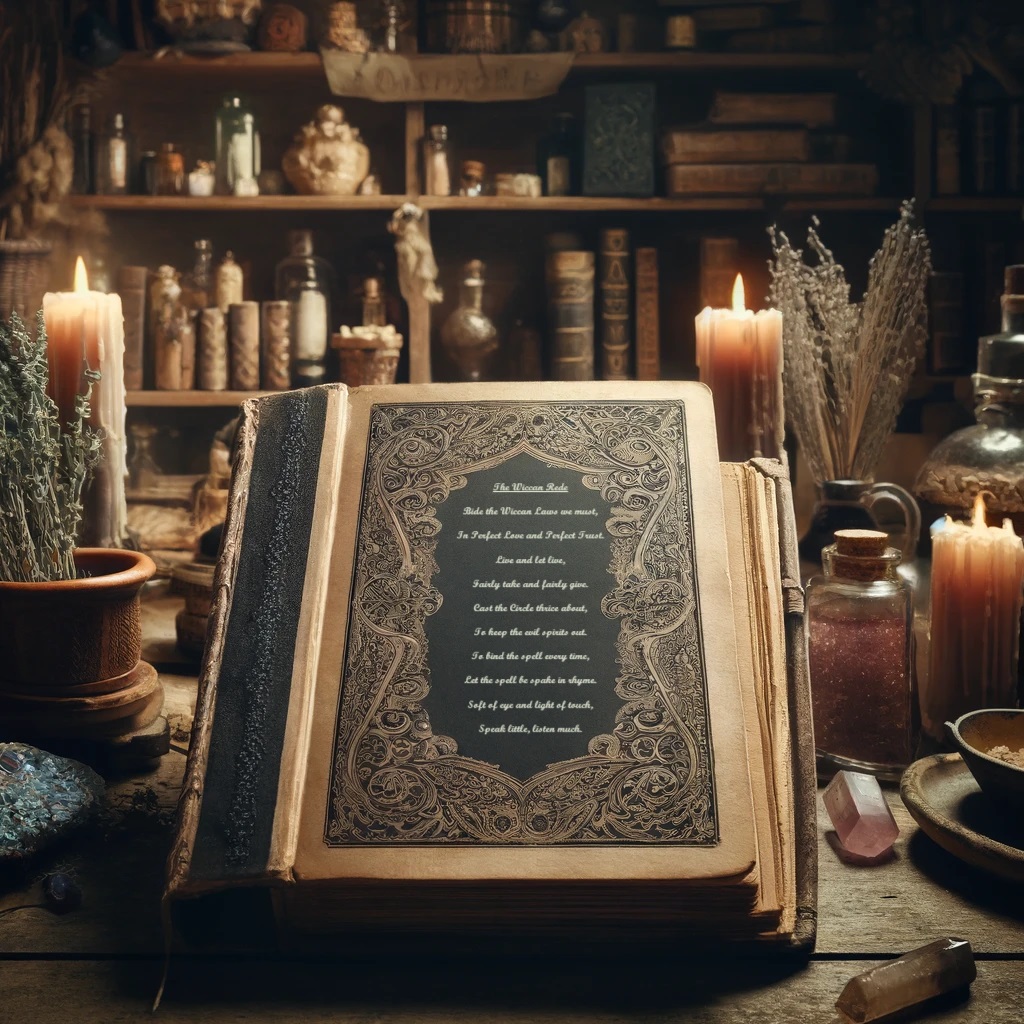
The long version of the Wiccan Rede is often presented in the form of a poem, which provides more specific guidance on various aspects of magical work and ethical living. It covers everything from the phases of the moon to the ethical implications of using certain types of magick. The core idea remains the same: if your actions do not cause harm, you are free to pursue them. Check out the long version below:
The Wiccan Rede (long version)
“Bide the Wiccan Laws we must, In perfect love and perfect trust.
Live and let live. Fairly take and fairly give.
Cast the Circle thrice about to keep the evil spirits out.
To bind the spell every time let the spell be spake in rhyme.
Soft of eye and light of touch, Speak little, listen much.
Deosil go by the waxing moon, chanting out the Witches’ Rune.
Widdershins go by the waning moon, chanting out the baneful rune.
When the Lady’s moon is new, kiss the hand to her, times two.
When the moon rides at her peak, then your heart’s desire seek.
Heed the North wind’s mighty gale, lock the door and drop the sail.
When the wind comes from the South, love will kiss thee on the mouth.
When the wind blows from the West, departed souls will have no rest.
When the wind blows from the East, expect the new and set the feast.
Nine woods in the cauldron go, burn them fast and burn them slow.
Elder be the Lady’s tree, burn it not or cursed you’ll be.
When the Wheel begins to turn, let the Beltane fires burn.
When the Wheel has turned to Yule, light the log and the Horned One rules.
Heed ye flower, Bush and Tree, by the Lady, blessed be.
Where the rippling waters go, cast a stone and truth you’ll know.
When ye have a true need, hearken not to others’ greed.
With a fool no season spend, lest ye be counted as his friend.
Merry meet and merry part, bright the cheeks and warm the heart.
Mind the Threefold Law you should, three times bad and three times good.
When misfortune is enow, wear the blue star on thy brow.
True in love ever be, lest thy lover’s false to thee.
Eight words the Wiccan Rede fulfil: An ye harm none, do what ye will.”
Meaning and Ethical Implications
The central tenet of the Wiccan Rede, “An it harm none, do what ye will,” appears quite straightforward—it champions personal freedom but places an important restriction on it: Do not harm. This is not just about avoiding physical harm, but also extends to the emotional, mental, and spiritual well-being of ourselves and others, and also to the environment around us.
In practice, this means Wiccans are encouraged to think deeply about the consequences of their actions. It’s about foreseeing potential harm that might come from any action and choosing a path that minimises negative impact. For magick, this is particularly important. The ethical use of magick is a cornerstone of Wiccan practice. Every spell or magickal working must be scrutinised through the lens of the Rede. Will this spell harm anyone? Could it have unintended consequences? These are critical questions that guide the ethical Wiccan practitioner.
Practical Implications in Magick
In terms of magickal practice, the Rede requires practitioners to consider the full impact of their workings. For example, a love spell intended to attract a specific person could interfere with that person’s free will, thus potentially causing harm. Instead, a Wiccan might cast a spell to open themselves to the possibility of love more generally, thus aligning their magickal workings with the Rede’s guidance to harm none.
The Rede also impacts how Wiccans gather and use magickal ingredients. For instance, when harvesting herbs, a Wiccan might leave enough for the plant to continue to thrive, reflecting a respect for nature that aligns with the Rede’s emphasis on harmlessness.
Implications in Everyday Life
Beyond magick, the Wiccan Rede encourages an ethical lifestyle that includes how one interacts with others and the environment. In everyday life, this might mean choosing products that are not harmful to the environment or being mindful of how one’s actions affect other people emotionally and physically.
The principle “An it harm none, do what ye will,” central to the Wiccan Rede, holds a profound place within Wiccan ethics. While it beautifully encapsulates the ideal of living in harmony with others and the world, its practical application can sometimes be complex and fraught with challenges. Let’s explore some of these impracticalities.
The Challenges of Following The Wiccan Rede
The Challenge of Defining “Harm”
One of the primary challenges is defining what constitutes “harm.” Harm can be subjective and varied, depending on individual perspectives. What one person considers harmless might be harmful to another. For example, in matters of emotional well-being, an action perceived as harmless by one, might cause emotional distress to another, unintentionally. This ambiguity can make it difficult for practitioners to ensure that their actions consistently align with the Rede.
Unintended Consequences
Even well-intentioned actions can have unintended consequences. In magick, as in life, the outcome of any action might not always be predictable. Spells cast to bring about a seemingly positive outcome could inadvertently lead to negative results for someone else. For instance, a spell aimed at bringing prosperity could unintentionally shift resources away from others.
Interactions with the Environment
The Rede’s directive to harm none extends to the natural world, but almost every action we take has some environmental impact. Whether it’s using herbs in rituals, driving to gather in sacred spaces, or even the footprint of the tools and candles used in practice, it’s challenging to ensure that no harm comes to the environment.
Balancing Personal Needs with the Rede
Wiccans, like anyone else, must make decisions in their personal and professional lives that may not always align perfectly with the ideal of harming none. For example, career choices, personal relationships or even dietary preferences can pose ethical conflicts when viewed through the lens of the Rede.
Absolute Harmlessness Is Impossible
On a broader scale, the concept of absolute harmlessness is impossible to achieve. Every interaction has potential consequences, and completely avoiding harm is not always feasible. This realisation can lead to ethical paralysis, where the fear of causing harm prevents action.
A Way Forward
Despite these challenges, the Rede serves as a guiding star rather than a rigid rule. It encourages mindfulness and responsibility. Wiccans often navigate these complexities by striving for the least harm and the greatest positive impact. They are encouraged to reflect deeply on potential outcomes and to make choices that align as closely as possible with the ideal of harmlessness, accepting that some compromises may be necessary.
In Practice
In practice, “An it harm none” is about making the best choices available and seeking a harmonious existence with others and with nature. This approach not only promotes ethical awareness, but also encourages compassionate application of Wiccan principles in everyday life. It is about minimising harm where we can. Take food for example: We all need to eat to survive. To not do so would (fatally) harm us. At the same time, there is no way to eat without causing harm (animals AND plants are living things). However, you could mitigate that harm by avoiding food waste, buying locally and ethically sourced food, or growing your own food where possible, composting and recycling packaging, and supporting farmers who use sustainable practices.
Final Thoughts
The Wiccan Rede is a powerful statement of ethics that serves as both a spiritual and practical guide for Wiccans. Its simplicity allows for wide interpretation but its message is clear: consider the impact of your actions and strive to cause no harm. By adhering to this principle, Wiccans navigate a path that is both liberating and responsible, ensuring that their freedom does not come at the expense of others.
Remember, the Wiccan Rede isn’t just about following rules—it’s about fostering a deep, personal understanding of how our actions connect us to the larger web of life. It encourages us to live consciously and ethically in a complex world, which is a powerful practice for anyone, whether or not they identify as Wiccan.
So, as you move forward in your studies or practice, keep these principles in mind. They will not only guide your magickal practices but also enrich your everyday life decisions, helping you to live in harmony with the world around you. Keep learning, stay curious, and always consider the full impact of your actions—this is the essence of living the Wiccan Rede.