Introduction.
When it comes to witchcraft ethics, The Threefold Law often causes debate. The Threefold Law is a Wiccan practice that serves as a guidepost for Wiccans, whether novices or seasoned practitioners. It is by no means followed by all witches and magickal practitioners. Some see it as limiting, others see it as a vital reminder to stay on course. But does it mean you can’t protect yourself or seek justice through magick? Not at all. In this guide, we’ll break down what the Threefold Law really means, how justice magick fits into it, the implications for our practices and how you can protect your energy without giving away your power.
What is the Threefold Law?
“Ever mind the rule of three.
What ye send out comes back to thee!”
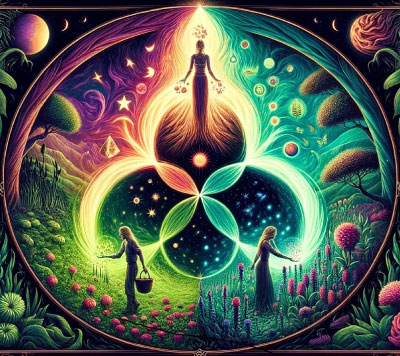
The Threefold Law is a Wiccan ethical principle that says whatever energy you send out—positive or negative—returns to you three times over. It’s not a threat, and it’s not cosmic punishment. It’s a reminder to be mindful of your vibrational frequency—as well as the intent and the energy you’re putting into the world.
Common Misconceptions About The Threefold Law
- It means you’re not allowed to defend yourself—FALSE
- It means you’ll be punished for simply feeling anger or hurt—FALSE
- It’s about being passive or overly “nice”—FALSE
- It is a reason to avoid dealing with your shadow self—FALSE
Think of The Threefold Law as energetic cause and effect: what you send out shapes the kind of energy you live in. In essence, this law serves as an ethical guideline, ensuring that Wiccans carefully consider the consequences of their actions, particularly when performing spells and magickal workings.
“Ever be the rule of three,
Three times what thou giveth returns to thee,
This lesson well thou must learn,
Thou only gets what thou dost earn!”
Alternative Interpretations
Some in the community say that The Threefold Law means witches should return three times what they receive, good or bad. Meaning, essentially, if someone bakes you a cookie, you should give them three cookies. If someone gives you a slap, you should slap them back three times.
Objections to The Threefold Law
Many witches outside of Wicca don’t follow The Threefold Law. Some see it as too moralistic or fear-based. Some view it as a modern rule made to make witchcraft look “safe”, one that limits or disempowers witches from standing up for themselves, rather than something rooted in older traditions. Others see it as a rule that requires you to reject a shadow part of yourself, such as anger or the desire for vengence. Many witches say they’ve never seen proof of this whole “three times” idea and prefer to use their own judgment instead. I respect all of these viewpoints – though I respectfully disagree. Every witch must discover what works for them.
The Threefold Law in My Practice
Personally, I follow The Threefold Law because, for me, it’s less about punishment and more about accountability. It reminds me to pause, do my shadow work, check my intentions, and consider the ripple effect before I cast. It doesn’t stop me from protecting myself or taking action when someone has crossed a line—it just stops me from going overboard or acting purely out of vengence. It’s a check-in, not a chain! I see it as a call to face my shadows and check my ego—rather than allowing them to run the show. If someone harms me, I can still return their energy to them or do a justified working. The Threefold Law just helps me stay grounded and focused on justice, not revenge.
Note: As The Threefold Law is a core principle that my own practices are rooted in, the content of this site will reflect that. You are, of course, free to disagree and choose the interpretation that you feel is best, or none at all. However, if you use baneful magick, please be aware my content may not resonate with you.
The Depth of the Threefold Law
While the Threefold Law might seem straightforward—do good things and receive good in return, do harm and receive harm—it encompasses much more complexity than it appears at first glance. This law pushes practitioners to deeply analyse the potential impacts of their actions, not just on themselves but on others and the environment.
Every action, every spell cast, every intention, is like a stone dropped into a pond. It can create a ripple effect that can extend far beyond the initial splash. A spell cast without considering its repercussions on others might come back to harm the caster in unexpected ways, emphasising the interconnectedness of all things. However, the Law of Return is not intended to disempower or make you avoid doing spells. Refusal to act when necessary can be just as harmful. The Threefold Law requires you to consider your impact, while understanding that we cannot move through life with zero impact.
The Threefold Law and the “An It Harm None” Principle
The “An it harm none, do what ye will” principle is one of the core ethical guidelines in Wicca. It ties directly into the Threefold Law. At first glance, “harm none” seems simple but, again, living without causing any harm is practically impossible. Every action we take creates effects, sometimes in ways we can’t predict. Even choosing not to act can sometimes cause harm. Importantly, the “harm none” includes you too. Self-harm, whether through neglect, poor choices, lack of boundaries, or self-destructive behavior, is seen as a breach of this principle. How you treat yourself matters just as much as how you treat others. Wicca encourages responsibility: act thoughtfully, knowing you’ll answer for your actions three times over. It’s not about being perfect; it’s about aiming to act with awareness and compassion, even knowing that perfection is impossible.
The Threefold Law and Shadow Work
The Threefold Law can actually be a powerful call to meet your shadow—not avoid it. It doesn’t ask you to pretend you’re all light and love. Instead, it challenges you to recognise your darker impulses, own them, and make conscious choices rather than reacting on autopilot. When you’re angry or hurt, the Law doesn’t say “you’re bad for feeling this.” It says, “what you send out comes back, so be sure this is what you truly want to carry.” It’s not about suppressing your shadow—it’s about working with it in a way that’s intentional and balanced. The Law encourages you to channel those intense emotions into actions that align with your values, rather than letting rage, jealousy, or vengeance run the show. It’s not about weakness or restraint for the sake of being “nice.” It’s about strength through self-awareness.
Implications of the Threefold Law
The implications of this law are deep. It teaches responsibility and encourages a thoughtful approach to witchcraft. Practitioners must consider the wider consequences of their spells: How might this spell affect someone else’s free will? Could this intention inadvertently bring harm? This contemplative approach not only fosters personal growth and wisdom, but also promotes a harmonious balance with the world.
The Complexity of Intent and Consequence
Considering the consequences of one’s magick requires more than just good intentions. Wiccans must think critically about potential outcomes, including long-term effects and the broader impact of their actions. This means being aware of the ethical components of each and every spell or ritual.
Think Before You Cast
The best strategy for adhering to this law is, first and foremost, to really think before casting any spell. Trying to get a rogue spell back isn’t always easy. It’s like trying to get a horse back after you opened the stable door. You may be able to retrieve it, but it could cause absolute carnage while it’s on the loose! And damage, once done, often can’t be undone. Here are some other tips to avoid negative consequences from your spell work:
Check Your Emotions:
- Never cast when you are very upset: While they can bring powerful energy, heightened or unresolved emotions can seriously cloud judgement, so take the time to regulate your emotions before you do any spell work. This can be easier said than done, but it’s important. If you are feeling emotional about a situation, do some shadow work and healing, and sleep on it.
- Always cast from a positive (or, at the very least, neutral) energy: Aside from clouding your judgement, casting spells from a negative, fearful, vengeful, or angry place affects the energy of the spell. This can be unpredictable and easily lead to unintended consequences. Even if you’ve worded the spell to sound positive, if your energy doesn’t match, it can affect the spell. This goes back to emotional regulation. If you are struggling to get into a positive or neutral energy, ask your Gods, ancestors, or your spirit guides to help you find balance.
- Never hex: This is a controversial take for some, but I don’t believe in hexing (i.e. baneful magick). After decades of practice and some seriously tough life situations, I’ve still never come across a moment where hexing was neccessary, or worth it. Even when someone absolutely deserved consequences, lowering my energy to that level felt like doing harm to myself, not just them. Hexing pulls you down to their level. It gives them power over your energy and focus. If you’re at the point where a hex feels like the only option, it usually means something in you needs healing—not revenge. That doesn’t mean you do nothing! I’m not advocating for anyone to allow others to harm them without consequence. There are powerful ways to protect, block, bind, transmute or return energy without dipping into baneful work. You can stand your ground magically without hurting yourself in the process.
Motivation and Empathy:
- Put yourself in their shoes: Considering a love spell? How would you feel if the object of your desire put a love spell on you? You’d be OK with that? OK… Well, what about if someone you weren’t attracted to put a love spell on you? Not so great now, is it? Always think about the people who are likely to be affected by your spell and how you would feel in their shoes.
- Check your motivation/biases: Ask yourself: “Do I want to help or do I want to control?”. Being truly aware of your own motivations and biases in spell work is crucial. For instance, someone recently asked me how they could do a spell to help their family member get pregnant. As I discussed the situation further with them, they disclosed that the family member in question was struggling to decide if they WANTED to have a child. However, the person asking about the spell really wanted their family member to have children. They meant well, but they weren’t aware of their own biases. I quickly brought their attention to the fact that such a spell would potentially be a hex, as it could bring about a pregnancy that their relative may not want. I suggested they should allow their relative to decide if they actually wanted children, and then support whatever decision they made. They could possibly do a fertility spell later, if their relative decided they did want to have children.
Alternative Solutions:
- Consider if there is a 3D solution: Is there a (non-harmful) action you could take in the 3D world that would resolve the situation? For example: Let’s say a colleague in your workplace is harassing you. Rather than using spell work to resolve the situation, would a chat with the colleague, or HR, be a more simple and suitable solution? Spell work and magickal practices can enhance your life. However, if you jump straight to spell work every time you encounter a difficulty in your everyday life, you may miss out on developing important life skills; such as problem solving, or learning how to be assertive and hold your boundaries.
- Consider using a different spell: There are usually more ways than one to achieve an objective with a spell. Consider a different approach. For example; Let’s say someone is sending negative energy to you or someone you love. You might be tempted to do the same to them and they’d deserve it. However, what you give out will come back to you, even if they fired the first shot! So, rather hitting back with a baneful spell, you could try a protection spell on their intended target or a transmutation spell.
Dealing with Unintended Negative Consequences
No matter how careful you are, there are times when spells may lead to unintended negative consequences. If you find yourself in such a situation, the first step is to acknowledge and accept responsibility for the outcome. Reflect on what went wrong and why, learning from the experience to avoid similar issues in the future.
To mitigate any harm caused:
- Reverse or Neutralise the Spell: If possible, perform an undo spell to neutralise it. Focus on restoring balance and healing any harm caused. Do this as quickly as possible to avoid further damage.
- Cleansing Rituals: Engage in personal and space cleansing rituals to clear any negative energies stirred up by the spell.
- Restitution: If your actions have harmed others, consider ways to make amends directly. This could be through apologies, helping to rectify the harm, or other restorative actions. If you can’t repair what you’ve done with the people involved, try to put some good out into the world in other ways to balance out the negativity.
- Reflection and Learning: Use this experience as a learning opportunity. Reflect on how your actions led to these consequences and how you can modify your practice in the future.
Final Thoughts
The Threefold Law is not just a rule but a wise counsel that steers practitioners towards more ethical and conscientious magickal practices. It serves as a constant reminder of the power of magick and the responsibility that comes with it. If you choose a witchy path, integrating the essence of The Threefold Law into your practice means committing to a path of growth, responsibility, and harmony with the world around you.
If you decide The Threefold Law doesn’t work for you, that’s completely your call. However, keep in mind that—whether you believe in the Law of Return or not— if you harm innocents, at the very least, it will affect you on a soul level. If you choose to understand and respect The Threefold Law, you may not only enhance your own spiritual journey but also contribute to the positive energies of the broader community and the natural world. This approach ensures that Wicca remains a force for good and a path of balance and wisdom.