
Casting a Circle:
The Wiccan & Non-Wiccan How-To Guide
Casting a circle is a foundational practice in many forms of witchcraft, both Wiccan and non-Wiccan. Whether you’re calling in the elements, creating a sacred space, or simply focusing your intent, a circle sets the stage for magick to unfold. For Wiccans, it’s often a formal rite involving deities and elementals. For non-Wiccans, it can be more intuitive—no strict rules, just energy and purpose. In this guide, we’ll walk you through what a magickal circle is, why you might use one, and how to cast a circle and open/close a circle your way—whether you’re in a coven or working solo.
We will cover:
- What Is a Magickal Circle?
- Why Do Witches Cast Circles?
- Why Some Witches Don’t Use Circles
- How Big Should Your Circle Be?
- Casting a Circle: The Wiccan Way
- Calling the Quarters
- Casting a Circle: The Non-Wiccan Way (Simple & Flexible)
- Casting in a Small Space or with Mobility Issues
- Stepping Out of a Magick Circle
- How to Open/Close a Circle
- Why is it called “opening” the circle?
- Final Tips
What Is a Magickal Circle?
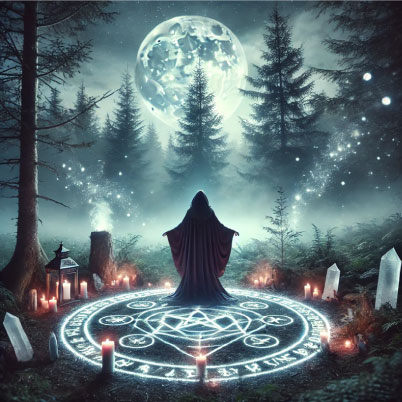
A magickal circle is a focused energetic boundary which witches use to contain, build, and direct energy during ritual or spellwork. Think of it like setting up your workspace before you start creating: it’s about focus, intention, and sacred space. The circle allows you to craft your spell, focus, build and amplify energy, and it protects from negative energy or outside influence.
You can cast a circle for:
- Ritual work (Sabbats, Esbats, dedications)
- Spellcasting
- Meditation or divination
- Protection during spirit or deity work
Some see it as creating a link between the physical and the spiritual. Others see it more practically—a way to shift your mindset and focus your will. To me, it’s both.
Why Do Witches Cast Circles?
There are three main reasons:
- Protection: The circle acts like a boundary, keeping unwanted energies out and your own energy contained.
- Energetic Container: It holds the energy you raise until you’re ready to release it. No leaks. No distractions.
- Sacred Space Creation: It shifts your mental and energetic state into a ritual mindset. It tells your subconscious, “We’re doing magick now.”
For Wiccans, the circle is often seen as a sacred temple between worlds. For non-Wiccans, especially folk witches or eclectic practitioners, the circle might be more casual, used only when needed, if at all!
Why Some Witches Don’t Use Circles
Not every witch bothers with a formal circle. Some reasons why:
- Folk practitioners may work with spirits or nature directly without needing a defined boundary.
- Chaos magicians may prefer raw intent over structure.
- Experienced witches might only cast a circle for big work, not daily spells.
- Energy sensitivity: Some find circles too intense or confining.
Bottom line? It’s your practice. If it feels unnecessary, skip it. If it helps, use it. There’s no magick police.
How Big Should Your Circle Be?
Traditionally, magick circles are often cast with a 9-foot (about 2.7 metres) diameter, especially in ceremonial or Wiccan practices. This size is considered large enough to comfortably move around, place tools, and perform rituals. However, it’s not a strict rule—many witches adjust based on their space and larger covens may need to adjust for more members.
In small areas (like apartments or bedrooms), a circle can be as small as your personal space—just enough to sit or stand in. Further down, you will find special instructions for casting a circle with limited space, or if you have mobility issues. What truly defines the circle is intention and energetic boundary, not physical measurement. Whether it’s 9 feet or 3, if the energy is clear and contained, the circle is doing its job.
Casting a Circle: The Wiccan Way
Here’s a basic Wiccan-style circle casting that calls the quarters (Air, Fire, Water and Earth) and invokes sacred space.
What You’ll Need:
- Wand, athame, or your finger
- Elemental markers (optional):
For East/Air—Incense or a feather
For South/Fire—A candle or a Carnelian crystal
For West/Water—Bowl of Water or a seashell
For North/Earth—A stone or some soil in a dish
You can also simply use candles in colours that correspond to that element:
For East/Air—Yellow
For South/Fire—Red or Orange
For West/Water—Blue
For North/Earth—Green or Brown
The Process
- Cleanse the Space:
Physically tidy up. Then smoke cleanse with incense, herbs, or sound. - Orientate yourself:
You need to know the location of each direction (North, South, East & West) in whatever space you are working in (as you need to face each direction as you call them in). - Ground & Centre:
Stand still. Take some deep cleansing breaths. Visualize yourself rooted like a tree. Call your energy into your body. - Cast the Circle:
Walk clockwise (deosil) around your space in a circle. As you walk, point your finger, athame or wand, and visualise a beam of light projecting out of it and forming the circle as you go. As you walk, say:
“This Circle round, I now do weave,
Between the worlds, I set this space,
As above, so below,
This magickal realm, this sacred place.”
Walk the circumference of the circle a total of three times, continuing to visualise the light forming the circle as you go. - Call the Quarters:
Face each direction, starting in the East. Raise your arms or point your tool and call in the Elemental for that direction. Call each quarter in order: East, South, West, then North. In the section below, you’ll find wording for calling in the quarters or you can create one that is unique to you (or your coven). As you call them in, you may visualise or sense the Elemental appearing at their direction. - Call the Goddess and God, Ancestors and Guides (Optional):
Invite your deities, ancestors or guides to witness or aid your working. - Begin Your Work:
You’re now in your circle. Do your ritual, spell, meditation, or divination.
Calling the Quarters
The words you use to call the quarters (also known as calling the corners) can be as simple or as complex as you want but ideally, should include the direction, element, and some of the qualities associated with that element (for example, East would be the element of Air which is associated with thought, communication etc). Below is an example of a wording you might use or you can create your own!
- East (Air): “Hail to the guardians of the East, Spirits of Air & intelligent thought, I call you forth to guard this circle, oh winds that whisper, wise and soft. I summon and stir you at this sacred hour, protect this space with your great power.”
- South (Fire): “Hail to the guardians of the South, Spirits of Fire & passion’s light, I call you forth to guard this circle, oh flames that dance, so fierce and bright. I summon and stir you at this sacred hour, protect this space with your great power.”
- West (Water): “Hail to the guardians of the West, Spirits of Water & intuitive feeling, I call you forth to guard this circle, oh rivers that flow so full of healing. I summon and stir you at this sacred hour, protect this space with your great power.”
- North (Earth):“Hail to the guardians of the North, Spirits of Earth & stable grounding. I call you forth to guard this circle, oh stones that stand with strength resounding. I summon and stir you at this sacred hour, protect this space with your great power.”
Note: Rhyming any of your rituals or spellwork is always optional. However, it can make remembering the words easier and can be especially helpful with spells you need to chant as it’s easier to get into a rhythm if the wording rhymes.
Casting a Circle: The Non-Wiccan Way (Simple & Flexible)
For witches who don’t follow Wiccan structures, here’s a non-Wiccan style.
- Ground and Breathe:
Connect with your energy and the earth below. You don’t need fancy tools, just your will. - Cast with Visualisation:
Stand in the centre. Raise your arms or spread them out.
Imagine a bubble of energy forming around you. You can walk in a circle if it helps, or just turn in place.
Say:
“Circle of energy, strong and bright, Protect this working with your light. No harm may enter, no power may stray, until my work is done this day.” - Set Boundaries with Intention:
You can whisper something like:
“This space is mine. This space is safe. Only what serves my highest good may enter.” - Begin Work:
Once you feel the energy settle, start your ritual or spell. Trust your intuition
Casting in a Small Space or with Mobility Issues
Not every witch has a garden or spare room. Here’s how to cast in limited space like a tight corner, bedroom, or even a closet:
- Stand in place and turn to each direction as you cast. You don’t have to walk a full circle. You can simply turn in place visualising white light projecting from your wand, athame or finger, creating a circle of light around you.
- You can use a circle rug or mark the floor with salt, rope, or your finger.
- Visualisation is enough. Energy goes where you direct it.
- Tools are optional.
For those with mobility issues, it is important to know how to cast a circle with limited mobility. You can use a tabletop altar and mentally cast the circle around it. You don’t have to stand or move, just visualise the circle forming around you and visualise yourself turning to each direction to call the quarters.
If you are casting in a small space, be especially careful with candles, incense and spells that require you to burn items, and always keep a fire extinguisher handy!
Stepping Out of a Magick Circle
If you ever need to step outside your magick circle mid-ritual—maybe to grab a forgotten tool or handle an interruption—you don’t need to break the whole circle. Instead, you can “cut a door” or open a gap in the circle’s edge to temporarily exit without disrupting the energy flow.
To do this, use your athame, wand, or even your hand. Visualise parting the energy like a curtain as you trace a door shape (usually a vertical rectangle or arch) in the air. Step through respectfully, and when you return, “seal” the door by retracing the shape and reaffirming the circle’s boundary. Some witches also place a broom at the edge of the circle to mark a gateway or entrance, especially during sabbats or initiations.
This technique keeps the integrity of your circle intact while allowing flexibility when life happens. Just be sure to step through consciously, with intention, and re-ground your focus when you return.
How to Open/Close a Circle
This part is just as important. Always release what you call in.
In Wiccan Style:
Go to each quarter in reverse order (North, West, South, East) and thank the elements:
“Hail to the Guardians of the North,
I thank you for your aid and grace,
Return now to your lovely realms,
I bid you farewell as you depart this space”
Repeat for West, South and then East, adapting the lines.
Walk counter-clockwise (widdershins) around your space to release the circle.
Say:
“Let the circle be open but never broken”
Non-Wiccan Style:
Thank the energy and guides in your own words. Imagine the bubble dissolving or being absorbed back into the earth.
Say:
“The circle ends, the work complete, I close this space and ground my feet.”
Then stomp your foot, touch the ground, or clap to break the energy.
Why is it called “opening” the circle?
The terms “opening” or “closing” the circle can be used to refer to ending the proceedings once the spellwork, ritual, or celebration we cast the circle for is complete.
Some call it “opening the circle” because when we cast the circle, we are energetically “closing off” a sacred space—separating it from the mundane world. The circle acts like a boundary, holding energy in and keeping outside influences out. So when the ritual or spellwork is done, we “open” that boundary back up.
Think of it like opening the lid on a cooking pot or opening a door. You’re not destroying the circle—you’re releasing it and signalling that this part of the working is complete. However, the energy you built up within the circle may have a further purpose—in the case of spellwork for example—so by opening the circle you’re allowing that process to begin.
At the same time, you are bringing the proceedings to a close so some witches prefer to call it “closing the circle“. You can use whichever you feel comfortable with.
Final Tips
- Don’t panic if you forget a line. Magick is flexible.
- If you’re interrupted mid-ritual, pause, ground yourself, and reaffirm your intention before continuing.
- Always ground yourself after big energetic work: eat, touch grass, drink water.
Casting a circle isn’t about being perfect. It’s about intention, protection, and presence. Use what feels right, adapt what doesn’t. Whether you’re a Wiccan, folk witch, or solo hedge witch, the circle is a tool—not a rule.