Introduction to the Great Mother Goddess and the Great Horned God
In this introduction, we explore the central figures of our practice: the Great Mother Goddess and the Great Horned God. We will discover how to connect with these deities in your daily practice, understand their roles in spell work, protection, and spiritual growth, and how calling upon gods and goddesses from various pantheons can enhance your magickal work.
The Core of Wiccan Worship: The Great Mother Goddess and the Great Horned God
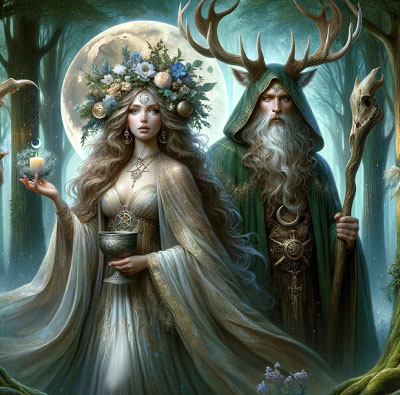
In Wicca, the worship of the Great Horned God and the Great Mother Goddess (also referred to as The Lord and Lady) forms the foundation of our spiritual practice. These deities represent the dual aspects of the Divine, embodying the balance of masculine and feminine energies, and the cycles of nature and life. They are seen as equally important in many traditions.
However, there are variations. For example, some traditions only worship the Goddess, or place her as more important than the God (as with many aspects of Wicca, there are vastly diverse opinions on deities and the appropriate ways to worship and work with them).
The Great Mother Goddess
The Great Mother Goddess is the Divine Feminine and is viewed as the nurturing force of life, overseeing growth, fertility, and wisdom. She is the Earth and mother nature, a symbol of abundance and the cycles of the seasons. She is also the Moon, mother of magick, mysteries and the occult, and is often depicted as the Triple Goddess—Maiden, Mother, and Crone—each aspect reflecting her powers of creation, nurturing, and transformation.
The Great Horned God
The Great Horned God is the Divine Masculine and is often seen as the Sun to the Goddess’s Moon or the yang to her yin. He is associated with nature, wilderness, sexuality, hunting, and the life force that runs through all animals and plants. He is also depicted in the cycle of the seasons, particularly linked to the sun’s annual death and rebirth (see the Wheel of the Year).
How to Worship and Work with Deities
Engaging with the Great Mother Goddess and the Great Horned God is not just about rituals; it’s about integrating their energies into your daily life. Here are some practical ways to connect with them:
- Altar Setup: Dedicate a space in your home for an altar. Use symbols like a moon for the Goddess and a horn for the God. You might also include representations of the elements—earth, air, fire, water—and natural objects that feel meaningful.
- Daily Devotions: Spend time each day in meditation at your altar. Speak to the Goddess and God, ask for their guidance, and listen to what they might communicate to you through your intuition or signs throughout your day.
- Celebrating Sabbats and Esbats: Honour the deities during the Wheel of the Year celebrations. Each sabbat aligns with their stories and energies, from the rebirth of the God at Yule to the fertility of the Goddess at Bealtaine. Esbats tend to be more focused on the Goddess due to her assocation with the moon. However, the God can be honoured and called upon for assistance, protection and complementary energy during esbats too.
- Crafting Spells and Rituals: When performing spell work, call on the Goddess and God to bless your intentions. For example, invoke the Goddess for spells related to healing, love, or abundance, and the God for protection, courage, or prosperity.
- Gratitude: Always remember to show gratitude to the God and Goddess for the blessings they bestow upon you. When you perform spell work express gratitude, safe in the knowledge that they are assisting you for your highest good before you’ve even closed the circle.
Enhancing Spell Work, Protection, and Spiritual Growth
The Great Mother Goddess and the Great Horned God are powerful allies in spell work and protection. They bring their energies to aid in these workings, enhancing the effectiveness and depth of your rituals.
- Spell Work: Before casting a spell, clearly state your intention and which deity you are invoking. For instance, a fertility spell could be enhanced by invoking the Great Mother Goddess, asking for her creative and nurturing power.
- Protection: Create protective charms or talismans by invoking the God or Goddess. Ask for their shield against negativity or harm, and carry these items with you or place them in your home.
- Spiritual Growth: Work with the deities through meditation and visualisation practices. Envision the Goddess’s nurturing light or the God’s empowering energy filling your spirit, guiding you toward wisdom and self-awareness.
Direct Connection to Deities
Wicca doesn’t come with a huge rulebook of dos and don’ts, nor does it promote a distant relationship to the God and/or Goddess. We have very simple, yet very effective, principles that guide us and keep us accountable for our actions. We are responsible for what we put out into The Universe, and we have a direct connection to our deities. Some covens may have additional guidelines for their members to ensure the harmony and clarity of a shared purpose. Likewise, practitioners may elaborate on how they apply Wiccan principles in their own lives. However, at the end of the day, your Wiccan practice is YOURS, as is your connection to the God and Goddess, and other deities.
This can be a difficult concept for followers of more rules-based religions to grasp. In Wicca, there is no “middle man” between you and the Gods. The concept can seem odd to those from a religious background where there are lots of very specific rules to live by, or their relationship to their higher power is controlled by a religious authority. If you were brought up in a rules-based religion and have been called to Wicca, don’t be afraid of the direct connection. You will get used to it and you’ll quickly grow to love it.
“My Gods Love Me and Are Pleased When I’m Happy”
As we’ve seen, worship of the God and Goddess in Wicca markedly differs from practices seen in some other religions, particularly in the relationship dynamics between the divine and the practitioners. Beliefs and practices vary among the witchy community. However, the belief in deities is fundamental to Wicca. Another concept within this is that our deities not only love us, but derive joy from our happiness and spiritual growth. This contrasts with some religious traditions where the relationship with deities may be governed by fear of divine wrath or punishment.
Respect and Love
In Wicca, the God and Goddess are generally viewed as figures who are accessible and relatable, as well as divine. They are not seen as distant or judgmental, but as part of the natural world and deeply involved in the well-being of their followers. This approach encourages Wiccans to engage with these deities on a personal level, seeking guidance, protection, and support in a reciprocal relationship based on respect and love, rather than fear. The God and Goddess are treated with the utmost respect and reverence, as they deserve.
Understanding Dualism
Wicca, as a spiritual path, does not adhere to a strict division of supreme good versus supreme evil, particularly in its view of deities. This perspective is quite distinct from many other religious traditions that often classify entities and actions strictly as good or evil.
Deities and Their Dual Nature
In Wicca, gods and goddesses are seen as embodying both light and shadow aspects, reflecting the complexity of nature and human experience. Deities such as The Morrigan, who is associated with war and death, also represent protection and sovereignty. This dual nature underscores the belief that all traits are essential to the wholeness of life. Understanding and integrating these aspects can lead to greater spiritual maturity.
Shadow Aspects in Worship
When we engage with the shadow aspects of deities, we are not worshiping darkness or evil but are acknowledging the full spectrum of the deity’s power and influence. This acceptance allows practitioners to engage with the gods and goddesses more fully, understanding that each has complex qualities that can teach valuable life lessons. Rituals and invocations often call upon both the light and shadow sides to harness a balanced view of existence.
Addressing Our Own Shadows
As we ackowledge the dual nature of deities, Wicca also encourages us to confront and integrate our own shadow sides. This process involves recognising and accepting our fears, faults, and negative emotions as part of ourselves. Wiccan practices such as meditation, ritual, and reflection are tools used to uncover and understand these hidden aspects. By doing so, we can achieve a deeper harmony and authenticity in our lives, leading to a more empowered and ethical practice.
Ethical Considerations
Again, there are ethical variations among the traditions. However, Wicca’s ethical framework, generally encourages actions that promote harmony and well-being. This is summarised by the Wiccan Rede “An it harm none, do what ye will,”. This ethical approach supports dealing with the shadow self not as something to be repressed or buried, but as an integral part of human experience to be understood and handled with compassion and honesty. We don’t hide from our shadows, we turn and face them.
The loving and supportive nature of the deities is often emphasised in Wiccan rituals and celebrations. These often focus on joy, personal growth, and harmony with nature. My own experience has always been that the God and Goddess want us to thrive. They provide the tools and opportunities for personal development and spiritual growth. For this purpose, they may also bring us lessons and accountability. This positive relationship fosters a spiritual environment where worship stems from love and respect, greatly enriching the personal and communal practice of Wicca.
Working with Specific Gods and Goddesses from Various Origins
The Goddess and/or God are central to Wiccan worship, and some traditions focus solely on them. However, many also worship or call upon deities from various cultural pantheons to aid or enhance their magick. For instance, you might invoke Aphrodite when you need to embody more self-love or Isis when you need protection. This is how I myself practice.
How I Work
I worship The Great Mother Goddess and The Great Horned God, but I also connect with deities from different pantheons for specific purposes, or when I feel called to. To me, those deities represent the Great Goddess or God’s energy, providing a particular trait, energy, or assistance I may need at the time. I treat them with the same reverence, respect, and gratitude. Sometimes, I’ll get signs that a particular deity is connecting with me. I don’t always initially know why. However, the reason tends to become apparent with time as I work with them. For example, I could feel called to connect with a protective deity and later discover why their protection was needed.
I have outlined some of the popular pantheons. To learn more about them click the buttons below:
Obviously, there are many more wonderful deities across various cultures around the world, too many to cover here! When working with any deity, always do so with respect for their origins and contexts. Learn about them, their stories, their cultures, and what they embody. This respect and understanding deepen your connection to their energies. In fact, making the effort to research them is a form of worship in itself.
Finding The Path for You
How you approach working with deities is deeply personal. Certain traditions or covens may have specific approaches, which you may be expected to honour if you join them. However, if you choose the solitary path, you will likely have a lot more freedom in this regard. You can worship The Great Mother Goddess, The Great Horned God, or both. If you have a cultural connection to certain deities, you may feel called to worship them. In fact, embracing this aspect of your heritage may be very rewarding. You may also worship specific deities from any pantheon you feel called to. Whether they are viewed as separate entities or facets of the same energy, is really up to you.
You can invoke any deity to aid your magickal rites or spell work. However, working with one whose traits or story resonate with your goals or objectives may be beneficial. Signs and synchronicities may present themselves when you are being called to work with a particular God or Goddess.
Supreme Deity
Some of the prominent figures in Wicca have also acknowledged an unknown higher power. A supreme deity of The Universe, which they considered to be a force beyond our comprehension. This may be referred to by various names such as the Prime Mover, The One etc. Some witches and pagans do not subscribe to this belief at all. They view this concept as just monotheistic religious beliefs finding their way into paganism.
To some, this supreme deity is viewed as a separate entity above the God and Goddess. To others, the Gods and Goddesses are all facets of this supreme power. Personally, I think of it as separate and interconnected, all at once. To me, it is the level all deities operate from. It is also the highest power of The Universe. I refer to it as “The Universe”, but I don’t tie myself up in knots trying to figure it out. To me, that would be like an ant in a garden trying to comprehend the vastness of our whole planet. Some things are simply beyond our comprehension and that’s OK!
Final Thoughts
Worshipping the Great Mother Goddess and/or the Great Horned God forms the bedrock of Wiccan spiritual practice. It enriches our magickal workings and personal growth. By understanding how to connect with these powerful deities and respectfully incorporating gods and goddesses into our practice, we open ourselves to a fuller experience of the magickal and the divine. Whether you’re drawing down the moon, celebrating the Sabbats, or crafting a simple spell, remember that the divine is always with you, guiding and protecting your path.